Skip to content

Crafts & forestry

Cut by hand,
grown in the forest.

The New Forest is not a wilderness and never was. It is a wood that has been worked for a thousand years — coppiced, grazed, felled and replanted — and the crafts that shaped it are still being practised in yards and clearings across the National Park.

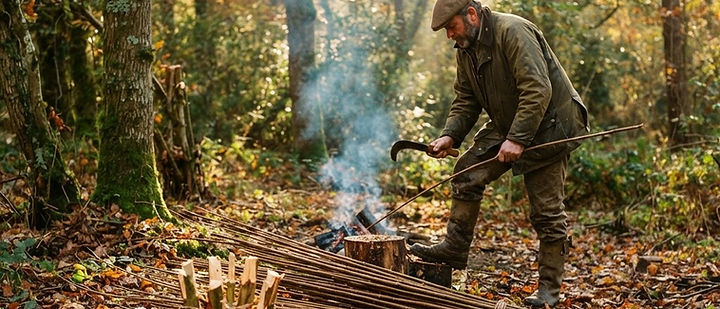
A woodman cutting hazel rods from a coppice stool in a New Forest wood in autumn

Coppice cutting near Burley, late autumn

Woodland
Coppiced for centuries
Working season
Autumn to spring
Trades
Hurdles, charcoal, greenwood

A working wood

Nothing here grew straight by accident.

Every beech avenue and hazel stool on the forest has been cut, grazed or planted by someone. The commoners' ponies and pigs keep the heath open; the woodsmen keep the coppice in rotation; the crafts follow the wood out of the wood — hurdles, spars, charcoal, fencing, boat timber.

You do not have to look far to see it. Smoke from a charcoal clamp, a stack of hurdles at a garden gate, or a carver's bench at a country show: this is a living industry rather than a museum exhibit.

What comes out of the wood

  • Hazel hurdles & screening
  • Charcoal, bagged in the wood
  • Cleft chestnut fencing
  • Spars and thatching timber
  • Oak for boat and bench
  • Greenwood spoons & chairs

The crafts

Four trades still worked in the forest

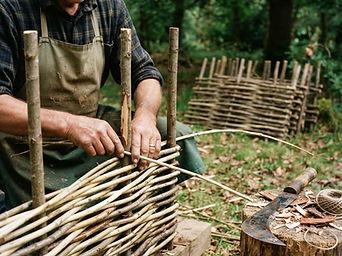
Hands weaving pale hazel rods into a traditional hurdle panel

Hazel hurdle making

Hurdles are the oldest fence in the forest and still the best-looking one: long coppiced hazel rods woven between stouter stakes, made on the ground with nothing but a billhook and a pair of hands. Cut in winter, woven in the yard, they last a decade or more and are used everywhere from cottage gardens to showground pens.

Minstead & Burley woodyards

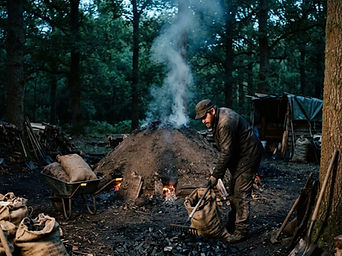
A charcoal clamp smouldering among oak trunks at dusk, smoke drifting through the wood

Charcoal burning

Walk the woods on an autumn evening and you may smell one before you see it. Charcoal burners stack seasoned cordwood into a clamp, cover it with earth and turf, and let it smoulder for days under constant watch, raking out lump charcoal that ends up in village shops and forest barbecues.

Woodlands around Burley & Minstead

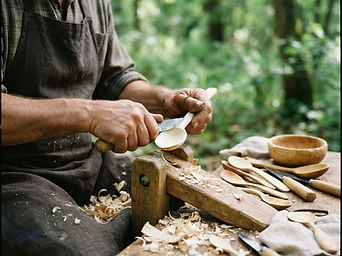
Hands carving a pale wooden spoon on a shave horse among wood shavings

Greenwood chairs & spoons

Green wood — unseasoned, still wet — bends and cleaves in ways dry timber never will, which is why the forest's chairmakers and spoon carvers work it fresh from the stump. A bodger's chair or a hand-carved spoon is a piece of a specific tree, and the shavings on the workshop floor tell you exactly which.

Workshops across the forest

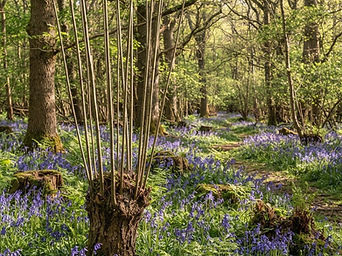
A coppiced hazel stool throwing up straight new stems above a carpet of bluebells

Coppice, timber & crafts

Cut a broadleaf stool to the ground and it throws up a dozen straight stems instead of one crooked trunk. That simple fact built the forest economy: hazel for hurdles and spars, chestnut for fencing, oak for boat keels and beams, sweet chestnut for hop poles. Cut on a cycle of seven to twenty years, the same stools have been harvested for centuries.

Throughout the National Park

Through the year

The forestry calendar

Wood work follows the seasons more closely than any other trade here. Cut in winter, weave in spring, burn in summer, stack in autumn.

  1. November – February

    The cut

    Coppicing is a winter job, done while the sap is down and the leaves are off. Hazel, chestnut and willow are cut to the stool, sorted into rods, stakes and cordwood, and stacked to season.

  2. January – March

    Hurdles and hedges

    The best rods go to the hurdle maker while they are still supple. Hedgelaying gangs work the boundaries at the same time, laying stems sideways so the hedge thickens rather than gaps.

  3. April – September

    Smoke in the wood

    Charcoal clamps are lit and watched through the warmer months. Meanwhile the spring flush hides the cut stools, bluebells come up through the coppice, and the wood looks nothing like a working one.

  4. May – July

    Timber and spars

    Oak and chestnut felled in the winter is sawn, cleft and stacked to season for fencing, boat work and building. Thatching spars are split from hazel and bundled ready for roofs.

  5. September – November

    Mast and pannage

    Acorns and beech mast drop, and the commoners' pigs are turned out for pannage to clear them. Firewood is stacked for the winter, and the first classes of the greenwood season begin.

Find it

Where to see it, buy it and try it

Out with the ponies while you are here? The wildlife guide covers the animals that keep this landscape open.

More guides

Sponsorship

Put your business in front of visitors planning a New Forest break — in town guides, our outdoor pages, the diary and the directory.

Promote your business