Skip to content

The wildlife guide

Ponies, deer,
and the quiet things.

The New Forest is not a museum of trees — it is a working landscape of heath, timber and coastline that happens to hold more rare wildlife than almost anywhere in lowland England. Here is where to look, and how to look without disturbing any of it.

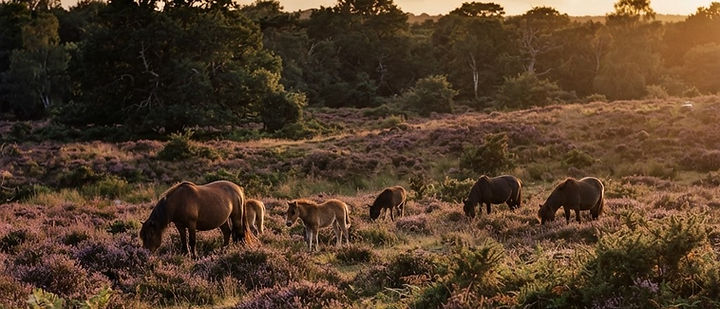
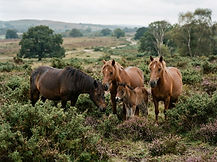
New Forest ponies grazing on open heather heathland at golden hour

Open forest near Bolderwood, an hour before dusk

Habitats
Wood, heath, coast
Best time
Dawn & dusk
Ponies roaming
Around 4,000

Before you go

Four things worth knowing

Look, don't feed

Ponies, donkeys and cattle are working animals belonging to commoners. Feeding them makes them beg on roads and turns them aggressive; keep three metres back and never block their path.

Dogs and ground nesters

The heaths are protected for ground-nesting birds. Keep dogs on a lead where livestock graze and between March and July on open heath, and always within sight.

Stay on the gravel

Heather takes decades to recover and the bog pools are fragile. Walking on the paths rather than through the heath keeps the forest worth photographing.

Dawn and dusk, always

Midday is for a pub. The forest's animals work the first and last hour of light, so plan a slow breakfast or a late picnic and see three times as much.

What to see

8 of the forest's residents · field recordings, freely licensed

New Forest ponies among gorse and heather on the open forest
01

The New Forest pony

Across the open forest

The animal the forest is built around. Around four thousand ponies run free here, owned by commoners whose families have held grazing rights for centuries, and each one is branded, counted and looked after by the agisters. You will meet them on the heath, in the villages, and standing in the middle of the road with no interest in moving.

Good to know — Never feed or touch them — they bite, they kick, and a fed pony becomes a dangerous one. Slow right down on forest lanes, especially at dusk.

Where
Open forest & villages
Best time
Early morning, dusk
Season
Year-round
Keep
Three metres back
Directions
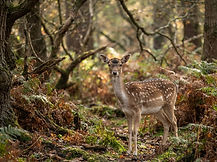
A fallow deer standing in dappled light in an oak wood
02

Fallow deer

Bolderwood & the oak woods

Fallow deer are the forest's oldest residents, and the herds here are among the largest in England. They spend the day deep in the timber and step out onto the lawns and rides at last light. The viewing platform at Bolderwood, where the keepers put out food, gives you the closest look without disturbing anything — but the best sightings come from sitting still at the edge of a clearing.

Good to know — Stay downwind and keep quiet. Binoculars turn a glimpse of backsides into an actual sighting.

Where
Bolderwood, Denny Wood
Best time
Last hour of light
Species
Fallow, roe, red, sika
Bring
Binoculars
Directions
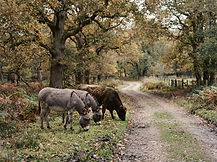
Donkeys and cattle grazing beside a leafy forest lane
03

Donkeys, cattle and pannage pigs

Burley, Bramshaw & the lanes

Ponies are only part of the picture. Cattle and donkeys graze the verges and the woods through the summer, doing the work that keeps the forest open, and in autumn the pigs come out. Pannage — usually from late September for around sixty days — releases hundreds of domestic pigs to eat the acorns and beech mast that would poison the ponies. It is one of the strangest and most photogenic weeks of the forest year.

Good to know — Pannage dates move each year with the acorn crop. Give pigs plenty of room, and never walk between a sow and her piglets.

Listen to it

Real field recordings, freely licensed via Wikimedia Commons.

Where
Burley, Bramshaw, Minstead
Season
Pannage in autumn
Also see
Cattle, donkeys, sheep
Keep
Gate closed behind you
Directions
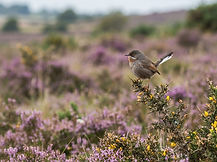
A small heathland songbird perched on gorse above purple heather
04

Heathland birds

Shatterford & Beaulieu Road

The open heaths are the reason the New Forest is a Special Protection Area. Dartford warblers skulk in the gorse, woodlarks sing on the wing in early spring, and on a warm June evening the nightjars start churring from the birch scrub and hunt moths over the heather. Curlew, stonechat and the occasional hobby complete the list on the wetter ground between the heaths.

Good to know — Head out an hour before sunset in May or June and stand still near gorse. Ground-nesting birds need dogs on leads from March to July.

Listen to it

Real field recordings, freely licensed via Wikimedia Commons.

Where
Shatterford, Beaulieu Road
Best time
Dusk, May–July
Look for
Nightjar, Dartford warbler
Dogs
Lead, Mar–Jul
Directions
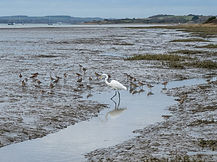
Wading birds and an egret on saltmarsh mudflats at low tide
05

Wetland and waders

Keyhaven & Lymington

Where the forest meets the Solent, the Lymington and Keyhaven marshes take over: a lattice of lagoons, saltmarsh and shingle that pulls in waders by the thousand through autumn and winter. Curlew, oystercatcher, dunlin and Brent geese feed on the falling tide, little egrets stalk the creeks, and the whole place turns gold in the hour before dusk. The path along the sea wall is flat and goes on for miles.

Good to know — Check a tide table — the best mud is exposed on a falling tide. Stay on the sea wall where birds are roosting on the saltmarsh.

Listen to it

Real field recordings, freely licensed via Wikimedia Commons.

Where
Keyhaven marshes
Best time
Autumn & winter
Look for
Curlew, egrets, geese
Access
Flat sea wall path
Directions
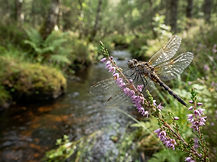
A dragonfly resting on a heather stem beside a clear forest stream
06

Bogs, dragonflies and adders

Crockford & Hincheslea

The quietest corner of the forest is also the richest. Clear gravel-bottomed streams run through the bogs, damselflies and dragonflies hunt along them in summer, and the heather edges are home to all three British snakes — adder, grass snake and smooth snake, along with the rare sand lizard. None of them want anything to do with you, but they are worth looking for on a still, warm morning.

Good to know — Adders bask on paths in spring. Watch where you put your hands and feet, keep dogs close, and never pick a snake up.

Where
Crockford, Hincheslea
Best time
Warm mornings
Look for
Dragonflies, adders
Ground
Wet — boots needed
Directions
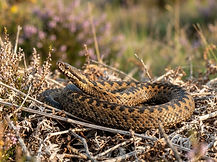
An adder coiled on dry bracken and heather on open heathland in spring sunshine
07

Reptiles of the heath

Beaulieu Heath & Crockford

The New Forest is one of the last places in Britain with all six native reptiles. Adders are the ones you notice — olive and copper with a bold dark zigzag down the back — but the heath also holds grass snakes near the wet ground, the very rare smooth snake and sand lizard on the dry western heaths, and common lizards and legless slow-worms in the bracken fringes. All of them are sun-driven: they emerge to warm up, then vanish the moment a shadow falls across them.

Good to know — Look, don't lift. Adders will only bite if trodden on or handled, so watch where you put hands and feet, and keep dogs to the path on warm mornings. Reptiles are fully protected — never pick one up for a photograph.

Where
Beaulieu Heath, Crockford
Best time
Sunny mornings, Mar–May
Look for
Adder, sand lizard
Keep
Eyes open, hands off
Directions
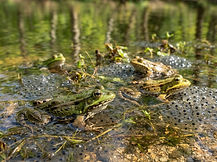
Common frogs half-submerged among spawn at the edge of a clear woodland pond
08

Frogs, toads and newts

Pondhead & the bog pools

The forest's shallow, gravel-bottomed pools are amphibian country. Common frogs arrive in numbers on the first mild nights of late winter, laying clouds of spawn in the shallows; common toads follow a few weeks later and head back to the same pond they were born in. Under the surface, palmate newts are everywhere and the great crested newt — a protected species here — lurks in the deeper, weedier pools. By May the tadpoles are thick in the margins and the herons have noticed.

Good to know — Watch from the bank rather than the water's edge, and never move spawn or tadpoles between ponds — it spreads disease. A torch after dark in March is the best way to see newts.

Where
Pondhead, Hincheslea
Best time
Feb–May, after dark
Look for
Frogspawn, newts
Bring
Torch & boots
Directions

Out for the day rather than the hour? The hiking guide has longer routes that put you in the good places at the right time of day.

More guides

Sponsorship

Put your business in front of visitors planning a New Forest break — in town guides, our outdoor pages, the diary and the directory.

Promote your business