
Forest history · Crown & kingdom
The king's forest,
and the price of it.
For eight hundred years the New Forest was run for one family's hunting. Forest law, royal lodges, a dead king in the oakwoods and a live one imprisoned on the coast: this is the part of the story the Crown wrote.
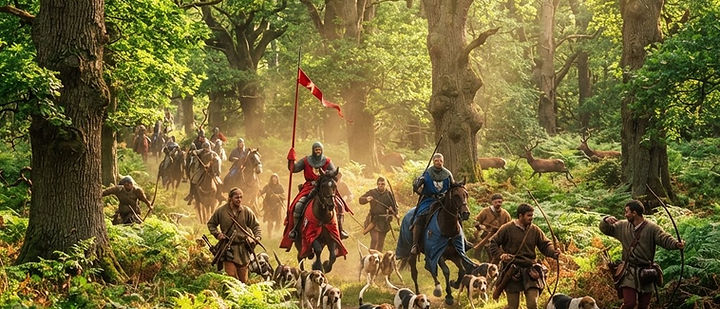
The king's hunt: why the New Forest was created, and why it still looks like this
- Royal forest set out
- 1079
- Rufus killed
- 2 August 1100
- Device forts built
- 1540s
The Crown's involvement is not a footnote to New Forest history. It is the reason the Forest exists as a single, recognisable place — and the reason its people spent centuries arguing with their landlord.
Forest law
A forest is a legal idea, not a wood
When William the Conqueror set out the Nova Foresta in 1079 he was not planting trees. A medieval forest was a defined area of land — woods, heath, bog, farmland and villages included — placed under a special royal law for the protection of game. The New Forest was simply the newest of them, and the name stuck.
Inside its boundary, ordinary law ran second. Forest law protected two things: the venison (the deer and the other beasts of the chase) and the vert (the greenery that fed and sheltered them). Killing a deer, cutting live wood or even clearing scrub without permission could cost a man his hand, his eyes or his freedom, and the penalties fell hardest on people who had farmed the same ground before the king ever saw it.
This is the part most visitors miss: the Forest was never empty, and it was never a wilderness. It was a working landscape of hamlets, churches, mills and smallholdings that a king requisitioned for hunting — and then had to negotiate with, because the people who lived there were still there.
The courts that enforced it
- Court of Attachment — met every forty days to record offences against the venison and vert.
- Court of Swainmote — sat three times a year to hear the recorded cases.
- Court of Justice Seat — the great assize, held every three years when the king's forest was surveyed.
- Verderers — the royal officers who ran the courts, and whose successors still sit in Lyndhurst.
1100
The death of William Rufus
On 2 August 1100 William II — Rufus, the Conqueror's red-haired son — was hunting in the Forest when he was struck by an arrow and killed. His companion Walter Tyrrell, a French nobleman, fled immediately for Normandy and never came back. The king's body was carried to Winchester, and his brother Henry rode hard for the treasury before anyone could argue.
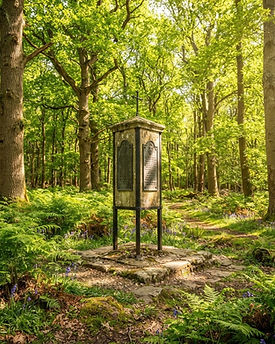
The chroniclers gave the story a detail that has kept it alive: the arrow glanced off an oak and went into the king's chest. Whether that is true, and whether Tyrrell loosed it, has been argued about for nine hundred years. The Rufus Stone, an eighteenth-century memorial later cased in iron, marks the spot near Canterton where the story says he fell.
Three explanations have all had serious supporters: a hunting accident of the kind that killed careless noblemen every decade; a deliberate killing by Tyrrell with or without a grudge; and a quiet conspiracy on behalf of the brother who was crowned three days later. Nobody will ever settle it, which is exactly why people still walk out to see a stone in a clearing.

The hunt
Deer, hounds and the King's House
Hunting in the Forest was a royal occasion: hounds, beaters, horses, and a household that moved with the court. The deer provided the meat, the sport and the prestige — a forest well stocked with fallow and red deer was a visible statement about the man who owned it.
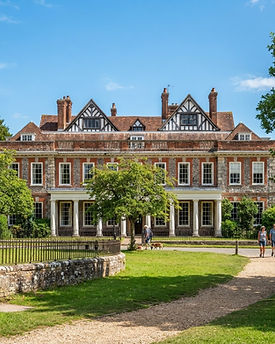
To make that work, the Crown needed buildings. The King's House at Lyndhurst began as a lodge for the Warden of the Forest, the nobleman charged with running the hunting and the law. Over the centuries it was rebuilt, extended and given the red-brick front you see today, with the Verderers' court behind it.
Lyndhurst grew up around that building. It calls itself the capital of the New Forest, and the claim is not decorative: for eight hundred years the administration of the whole Forest — courts, rights, timber, deer — has been transacted from a small village at its centre.

1648
The king in the fortress
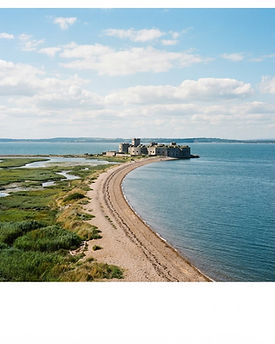
Henry VIII built Hurst Castle in the 1540s, one of a chain of 'device' forts guarding the Solent after the break with Rome made invasion a real fear. It is a squat, businesslike artillery fort on a shingle spit where the water narrows — a place to stop ships, not to impress visitors.
A century later it held a king. Charles I was brought to Hurst in the winter of 1648 and kept there for some weeks before being moved to Windsor and then to his trial in London. A fort designed to keep out the Spanish became the least likely royal residence in England.
Hurst kept working long after that. It was refortified in the Victorian era with great wings of brickwork, manned again in two world wars, and is now a ruin you reach on foot along a mile and a half of shingle with the Isle of Wight across the water.

1877 onwards
How the Crown lost the argument
For centuries the Crown's interest and the commoners' interest pulled against each other. Enclosure, timber sales and the planting of conifers all threatened grazing, and every generation produced a fresh dispute about what the Forest was actually for.
The New Forest Act 1877 was the turning point. It reconstituted the Verderers to represent the commoners rather than the Crown, protected the rights of pasture and pannage, and set out how the woods should be managed. Further Acts in the twentieth century strengthened the same settlement.
The result is a strange, workable hybrid: most of the land is still Crown land, managed today by Forestry England, while the grazing and the ancient court are still in the hands of the commoners. No single owner decides what the Forest looks like.
Today
The Crown's fingerprints on a modern landscape
Look at the Forest and you are looking at the Crown's legacy in three layers. The open lawns and heath exist because deer and then ponies and cattle have been grazing them for nine centuries. The oak and beech plantations in the woods were planted for navy timber. And the villages sit where medieval hamlets were allowed to stay.
Two echoes are easy to find. At Beaulieu, a wartime airfield has been returned to heathland and is now one of the best places in southern England to hear a nightjar. And on the edge of Lyndhurst, the same small court that once enforced the king's deer law still meets to hear about ponies, fencing and road signs.
Royal interest has not entirely gone, either: the Crown appoints a member of the Verderers' court, and the estate villages at Beaulieu remain a reminder that the Forest's largest landowner started as a king.
Questions people ask
Straight answers
Was the New Forest really made by William the Conqueror?
The royal forest was formally set out in 1079, under William I. But the landscape was already old: it had been farmed and settled for centuries, and the 'forest' was a legal overlay on land that people were living on.
Did forest law apply to ordinary people?
Yes, and harshly. Forest law ran alongside the common law and covered everything inside the boundary — including farmland and villages. Offences against the king's deer or timber were tried in forest courts, not the ordinary ones.
Who killed William Rufus?
Nobody knows. Walter Tyrrell loosed the arrow according to most accounts, but whether it was an accident, a murder or a conspiracy involving Henry I has never been established. The Rufus Stone marks the traditional spot rather than the truth.
Does the Crown still own the Forest?
Most of it, yes. The land is Crown land managed by Forestry England, while grazing and the ancient rights are administered by the Verderers. The 1877 Act is the reason those two things can coexist.
Keep going
Great houses & places
Walk into the buildings this history happened in — the abbey gatehouse, the Elizabethan manor, the clifftop castle.
Residents, past & present
Alice Liddell, Conan Doyle, a motoring baron and a naturalist: the people who chose to live here.
Commoning & rights
How the other half of the Forest's story works today: rights, brands and the autumn drift.
More guides
Beach guide
Six stretches of Solent coast, from Lepe to Highcliffe.
Walking guide
Short woodland circuits and longer heathland days.
Cycling guide
Gravel loops, family rides and coast runs on two wheels.
Wildlife guide
Ponies, deer, heathland birds and where to watch them.
Hiking guide
Six full-day routes, from six miles to eleven.
Crafts & forestry
Coppicing, hurdles, charcoal and greenwood work in the forest.
Commoning & rights
Who holds the rights, what they allow and how the stock is managed.
Forest history
Kings, abbey ruins, great houses and the people who lived in them.