Skip to content

Forest history · Residents

The people who
chose the quiet.

The Forest has always attracted people who needed quiet, space and a good walk. Some came for their health, some for the hunting, some because a house happened to be for sale. A few of them wrote books that outlasted the houses they lived in.

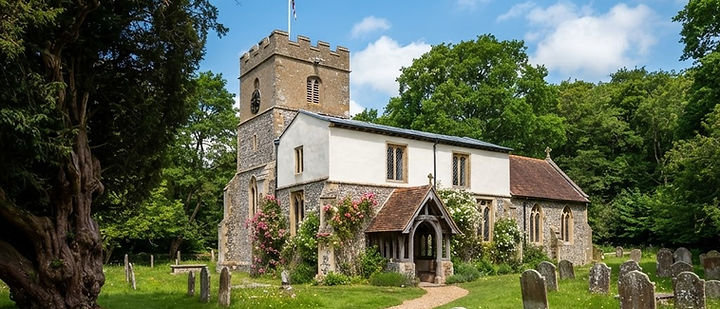
A small white-painted New Forest church with lichen-covered gravestones

Minstead churchyard, where one of the Forest's most famous residents is buried

The original Alice
Lyndhurst
Sherlock Holmes' creator
Minstead
Best-known resident today
A naturalist
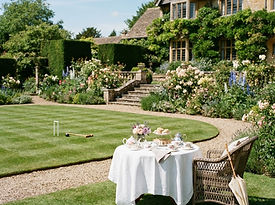
A country house lawn set for tea with a parasol and croquet hoops
Cuffnells, Lyndhurst

Alice Liddell

1852–1934

The original Alice

The child who asked for a story, and got Alice's Adventures in Wonderland out of it.

Alice Liddell was ten years old when she asked Charles Dodgson, a family friend and Oxford don, for a story during a boat trip in 1862. The story became Alice's Adventures in Wonderland, and she became the most famous child in Victorian England whether she liked it or not.

She grew up, married Reginald Hargreaves, and in due course came to live at Cuffnells, a country house in Lyndhurst. She lived here as a widow for many years, known to the village as a quietly formidable presence rather than a character from a book.

She is buried in Lyndhurst churchyard, a short walk from the Forest's busiest high street. It is one of the odder pilgrimages in England: people arrive expecting a fantasy and find an ordinary headstone in a Hampshire village.

Look for

  • Her grave in the churchyard at Lyndhurst
  • The village itself, which has leaned heavily on the connection ever since
  • Cuffnells — the house is private, but the forestry surrounding it is not
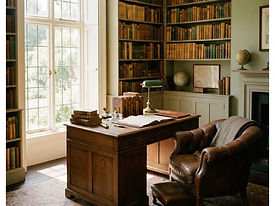
A writer's study with manuscript, inkwell and a sunlit window
Bignell Wood, near Minstead

Sir Arthur Conan Doyle

1859–1930

Creator of Sherlock Holmes

Sherlock Holmes's creator spent his last twelve years writing in a house near Minstead.

Conan Doyle came to the New Forest in 1918, looking for space, trees and a place to think at the end of a war in which he had lost family. He bought a house at Bignell Wood, near Minstead, and stayed until his death twelve years later.

He was already world-famous for Sherlock Holmes and thoroughly tired of him, spending his energy instead on spiritualism, historical novels and campaigning. Neighbours remembered a large, energetic man who walked the Forest at a pace that exhausted his guests and kept up a correspondence with everyone.

He was buried at Minstead — in the churchyard, after an initial grave in the garden — under a plain headstone with a cross. The church is a small, white, very English building, and the Forestry England car parks nearby make the walk to it easy.

Look for

  • His grave in the churchyard at Minstead
  • The church itself, with its box pews and foresters' memorials
  • The walk back through the enclosures to the village
Vintage cars displayed in a motor museum
Palace House, Beaulieu

Lord Montagu of Beaulieu

1926–2015

Motoring pioneer and conservationist

The man who opened a stately home to the public in 1952 and built one of Europe's great car museums in its grounds.

Edward Douglas-Scott-Montagu inherited a great house, an estate and a problem: in 1951 a home like Beaulieu could not be kept up on the income of a country estate. His answer was to open the house to the public — a decision that made him a pioneer of the stately-home business.

In 1952 he founded the National Motor Museum, filling the Palace House grounds with cars at a time when the country was falling in love with the motor car. It became one of the largest collections in Europe, and it paid for the roof.

He also became one of the Forest's more effective advocates: president of the New Forest Association and a campaigner on forestry, landscape and heritage for fifty years. The estate still runs the house, the museum and the village, and the family still lives in the building.

Look for

  • The National Motor Museum in the Palace House grounds
  • The house itself, which is still the family's home
  • Beaulieu village, built by the estate around the abbey's precinct
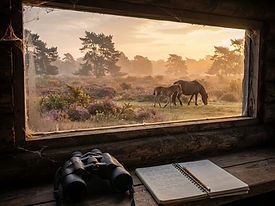
View from a wildlife hide over misty heathland at sunrise
The New Forest

Chris Packham

Present day

Naturalist and broadcaster

A naturalist who chose to live here, and who campaigns about what happens to it.

The Forest's best-known current resident is a naturalist and broadcaster who has lived here for years, in a house that tends to contain rescued animals. The surrounding heathland and woods are where his arguments about how we treat wildlife get tested.

He is a divisive figure nationally, but the local story is simpler: a person who lives on the Forest and keeps saying, loudly, that its wildlife is not there for decoration. Whether you agree with him or not, the case for protecting the Forest's heaths and its nightjars is made better with him in it.

For visitors, the practical influence is everywhere: the hides and boardwalks, the campaigns against heathland fires, the pressure for better river water. He is a reminder that this is a lived landscape, not a film set.

Look for

  • The New Forest's heathland hides at dawn
  • Nightjar country in late spring and summer
  • Any of the Forest's wildlife calendars — this is what he has spent years defending
An Edwardian country house garden with a tea table on the lawn
Embley, near Romsey

Florence Nightingale

1820–1910

Founder of modern nursing

Her family's house sat just beyond the Forest's western edge, and it is where she decided on nursing.

The Nightingales' house at Embley stood just past the Forest's western boundary, and it was here that Florence decided, at sixteen, that she had a calling to nursing — a decision her family found close to scandalous and resisted for years.

She spent a great deal of her early life in this corner of Hampshire: riding, visiting the poor in the villages, learning the household management that later turned into a talent for organising military hospitals, statistics and public health.

Embley is gone and the house is not open, but the village it belonged to is the kind of Hampshire village she would recognise, and the Forest edge she rode across is still there. She belongs in this list precisely because she chose to leave it.

Look for

  • The lanes and woods on the Forest's western edge
  • Romsey, which she knew well and which has a museum covering her early life
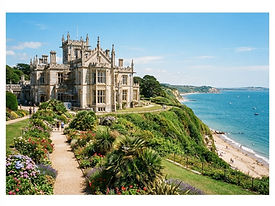
A Gothic Revival stone mansion on a green clifftop above a blue bay
Highcliffe Castle

Charles Stuart

1779–1845

Diplomat and builder

The ambassador who shipped pieces of medieval France home and built a Gothic castle from them on a clifftop.

Charles Stuart spent his career as a diplomat in France and Portugal, and came home with a plan less cautious men would have dropped: build an English house out of real medieval French masonry, arranged as a Gothic mansion on a cliff.

The result is Highcliffe Castle, built from the 1830s with carved stone and window tracery taken from elsewhere, and its improbable, romantic silhouette has been a landmark on that stretch of coast ever since.

He was the sort of person the Forest has always attracted — someone with money, a strong idea and no particular interest in restraint. The house outlived the ideas, burned in 1967 and was restored in the 1990s, so his monument is now a public one.

Look for

  • Highcliffe Castle's east window and the reused French carving
  • The clifftop garden above the bay
  • The view to the Needles on a clear day

Two graves worth the detour

Both are easy to reach on foot

Alice Liddell

Lyndhurst

The real Alice's headstone sits in the churchyard at Lyndhurst, a few minutes from the centre of the Forest's 'capital'.

Lyndhurst town guide

Sir Arthur Conan Doyle

Minstead

Buried in the churchyard at Minstead under a plain cross, in the village he came to for the writing and stayed in for the quiet.

Following in their footsteps? The walking guide has routes through Minstead and Lyndhurst, and the great houses page covers the buildings several of these people lived in.

Sponsorship

Put your business in front of visitors planning a New Forest break — in town guides, our outdoor pages, the diary and the directory.

Promote your business